




Duroxite® Cutting
DUROXITE ® IN FABRICATION DUROXITE®
Duroxite ® is designed to be hard, without giving you a hard time in the workshop.
With our broad offering of Duroxite ® products you can build, repair and maintain equipment for practically any application challenged by severe sliding wear.
PROCESSING AND INSTALLING DUROXITE ®
This brochure highlights the main processing and installation techniques for Duroxite ® . For further technical advice you are always welcome to contact our Duroxite ® specialists. Contact information is found at duroxite.com or by scanning the QR code.
CUTTING
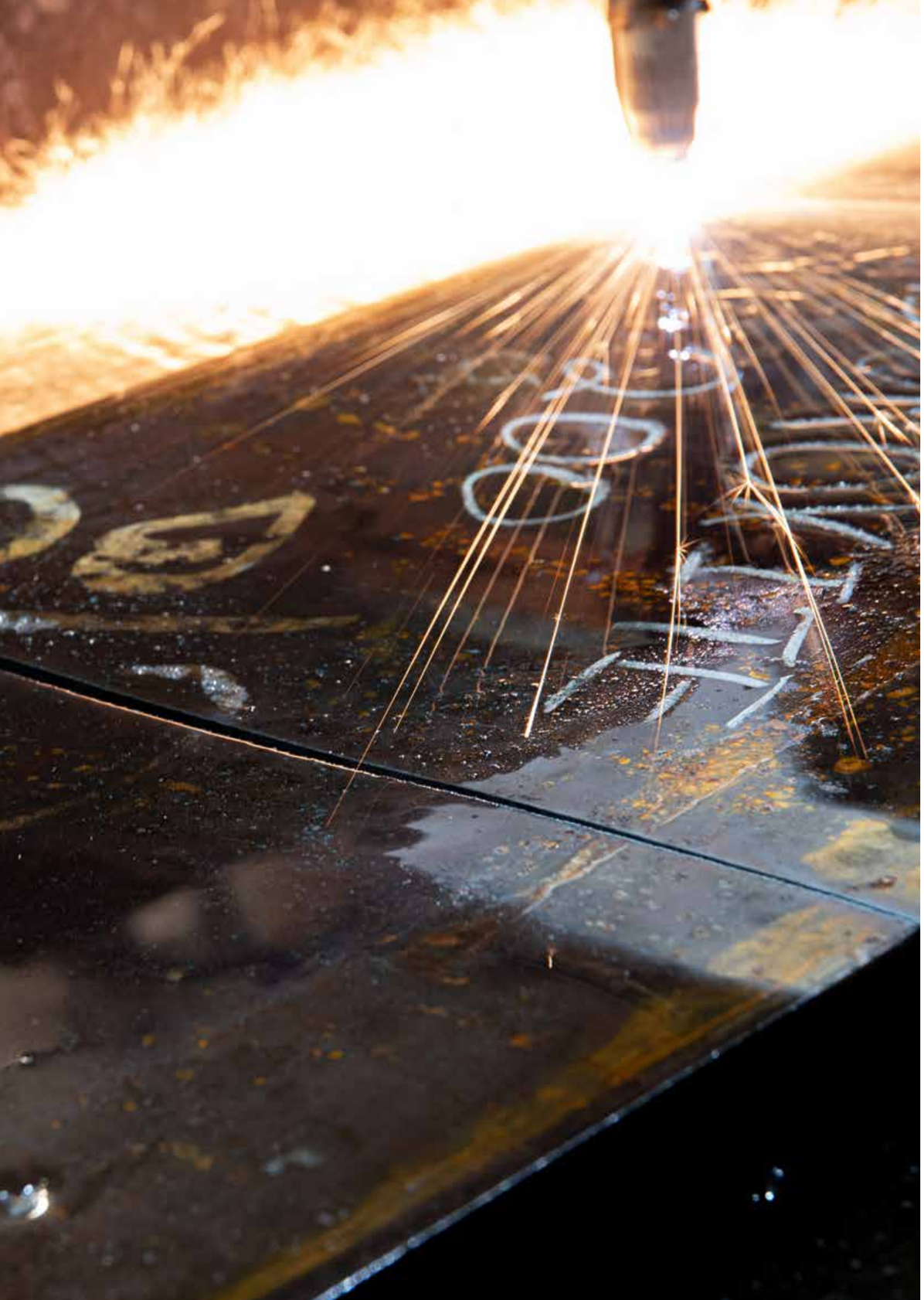
Duroxite ® overlay plates can be cut by plasma, laser, water jet, arc gouge, and abrasive saw cutting. However, it cannot be cut by oxy-fuel.
Duroxite ® should be cut from the base metal side to avoid carbon contamination. When beveling, Duroxite ® plate can be burned from the overlay side.
Cutting speeds need to be reduced compared to regular steel plate cutting because of the carbides.
For safety precautions when cutting Duroxite ® , see the welding section in the brochure.
RECOMMENDED CUTTING SPEED AT DIFFERENT PLASMA CURRENTS AND THICKNESSES
Duroxite ® overlay plate | Carbon steel | ||||
|---|---|---|---|---|---|
Plate thickness | 130 amps | 200 amps | 260 amps | 400 amps | 360 amps |
3 mm on 6 mm 1/8'' on 1/4'' | 1900 mm/min 75'/min | 2600 mm/min 105'/min | 3000 mm/min 120'/min | 3500 mm/min 140'/min | 4200 mm/min 165'/min |
6 mm on 6 mm 1/4'' on 1/4'' | 1900 mm/min 75'/min | 2600 mm/min 105'/min | 3000 mm/min 120'/min | 3500 mm/min 140'/min | 4200 mm/min 165'/min |
10 mm on 10 mm 3/8'' on 3/8'' | 1000 mm/min 40'/min | 1250 mm/min 50'/min | 1700 mm/min 65'/min | 2400 mm/min 95'/min | 4200 mm/min 165'/min |
12 mm on 12 mm 1/2'' on 1/2'' | 550 mm/min 20'/min | 1200 mm/min 45'/min | 1400 mm/min 55'/min | 1800 mm/min 70'/min | 4200 mm/min 165'/min |
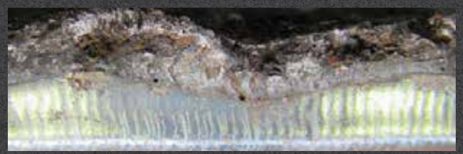
CUTTING FROM BASE METAL SIDE
Duroxite ® should only be cut from the base metal side to avoid carbon contamination. The cutting surface is smooth, the carbon contamination is eliminated, and there is a clear fusion line to separate overlay from base metal.
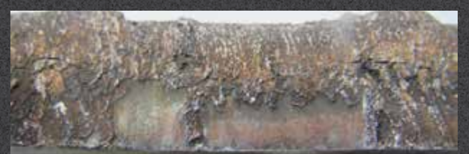
CUTTING FROM HARDFACING SIDE
When cut from the hardfaced side, the overlay materials flow into the base metal. The contamination from the overlay into the base metal cause a higher carbon equivalent, leading to an increased risk of cold cracking when welding.