
Water Jet Cutting
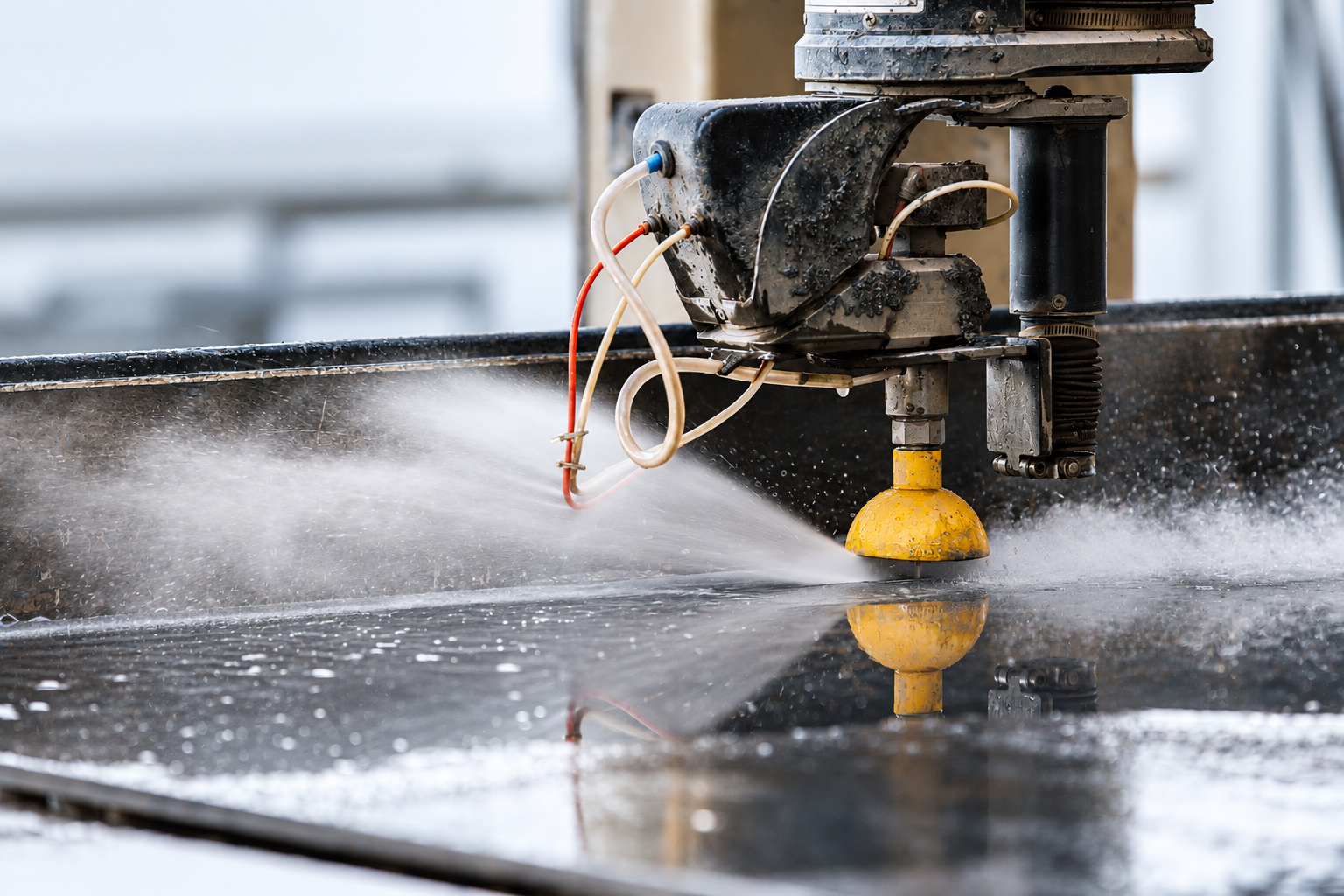
Abrasive Waterjet Cutting for Near-Net-Shape Parts
The ideal technology for quenched and tempered steels
Abrasive waterjet cutting is one of the most suitable technologies for near-net-shape cutting of quenched and tempered steels. Components are cut close to their final geometry, significantly reducing the amount of material that must be removed by subsequent machining.
Unlike thermal cutting, abrasive waterjet cutting creates no heat-affected zone. The hardness, toughness and mechanical properties of the steel remain unchanged along the cut edge. This makes the technology ideal for high-performance and pre-hardened steels such as Toolox®, Hardox®, Strenx® and 42CrMo4 QT.
Less machining. Lower production costs.
Near-net-shape cutting enables complex contours, internal openings and curved profiles to be produced directly from the plate. Compared with conventional rectangular blanks, shaped parts require less milling and generate less material waste.
The main benefits include:
•Shorter machining times
•Lower machining and tooling costs
•Reduced material consumption
•No thermal distortion or metallurgical changes
•Greater freedom in component design
•Faster overall production
OMAX 80X with two independent bridges
Our OMAX 80X abrasive waterjet cutting system is equipped with two independent bridges, providing outstanding production flexibility and capacity.
Each bridge can process a different order independently, allowing two separate jobs with different geometries and quantities to be cut at the same time.
For serial production, both cutting heads can operate simultaneously to produce identical components. Cutting two parts at once increases productivity, improves machine utilisation and shortens delivery times.
The OMAX 80X is therefore an efficient solution for individual components, complex near-net-shape parts and larger production series.
No heat-affected zone. Less machining. Two bridges for maximum productivity.
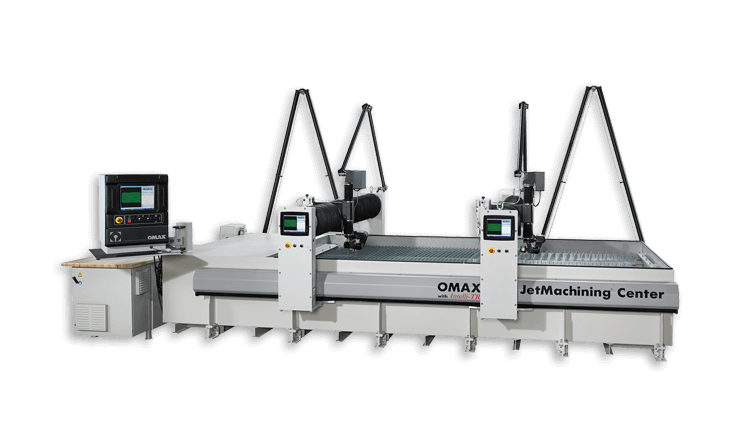
Technical information:
Cutting head: Tilt-A-Jet taper removal
Cutting range: 8.000 x 2.000 mm
Direct drive pump: EnduroMax 50HP
Operating pressure: 4.000 bar
OPERATION |  Water Jet Cuts |
|---|---|
TABLE DIMENSIONS | 8.000 x 2.000 mm |
MAXIMUM PLATE THICKNESS | 50 ˂ d ≤ 200 mm |
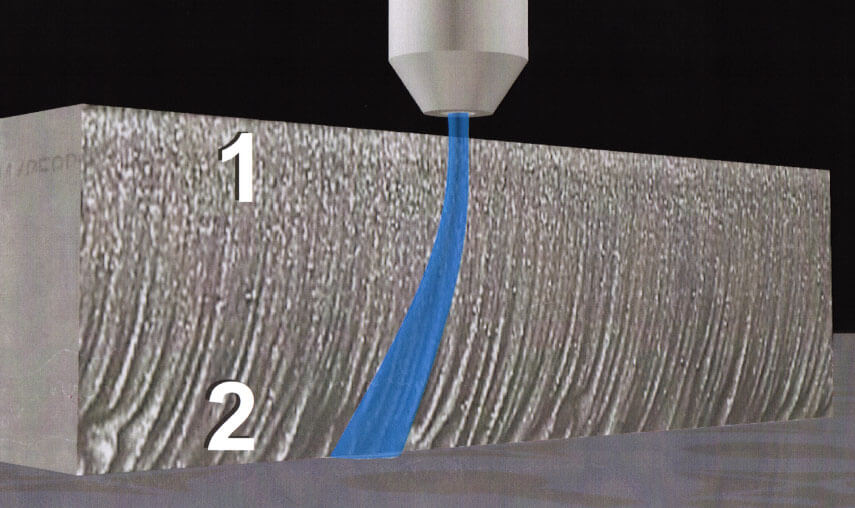
In abrasive waterjet machining, cutting speed and edge quality are directly related. In general, the higher the quality, the slower the cutting speed. It is possible to choose Q5 for every cutting job, but it may take two or three times as long to achieve Q5 than Q3 on the same part. Since the time taken to cut parts is usually a major factor in the cost of project, you must take into consideration the requirements in the job specification and select the appropriate edge quality to give you the edge quality you need at the fastest possible cutting speed
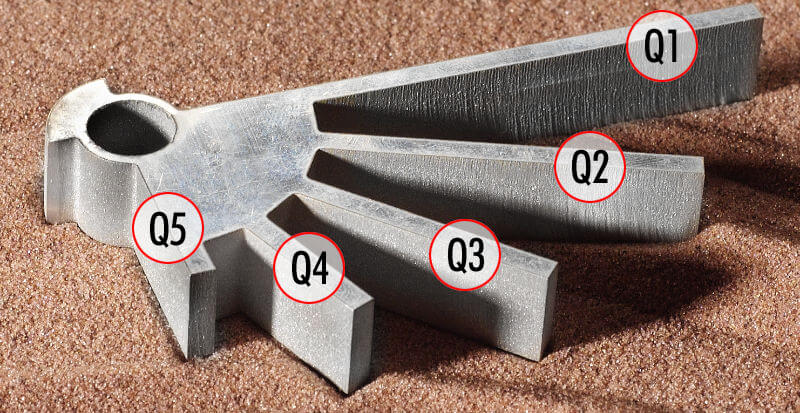
5 Options for Waterjet Cut Edge Quality
5 Options for Waterjet Cut
Edge quality Q1 separation cut produced by very fast cutting speed and Q5 high quality finish is only possible with low cutting speed.
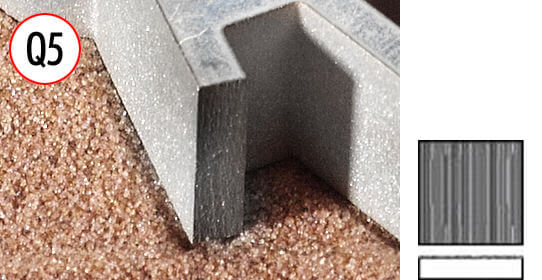
Quality 5 = very high-quality finish Q5
It is very precise and has no striations. Q5 produces the most accurate edge quality.
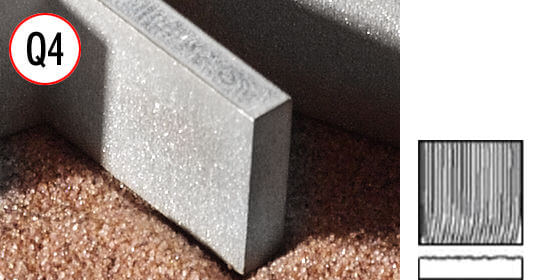
Quality 4 = high-quality finish Q4
It is a high quality finish. The striations are minimal.
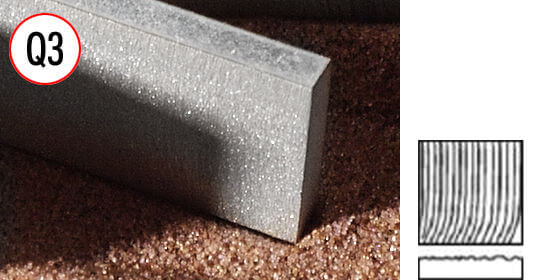
Quality 3 = Standard machining cut Q3
The quality is good with striations on the bottom half of the cut. Q3 is a little slower than Q2 and is the most commonly used edge quality.
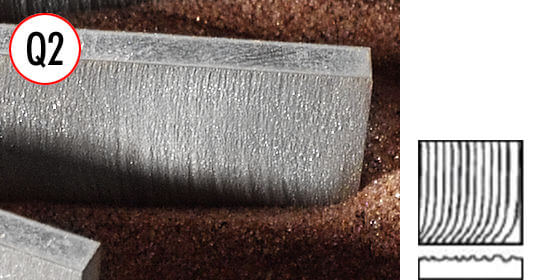
Quality 2 = Medium rough cut Q2
Q2 is a medium rough cut. The striations are less noticeable than in a Q1 edge and cutting speed is a bit slower than Q1.
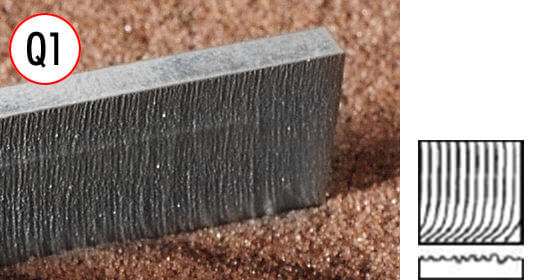
Quality 1 = Separation cut Q1
It’s a rough cut and the edge has pronounced lines, called striations. While Q1 does not produce a high-quality edge, it will give you very fast cutting speeds and can be used for roughing out parts.
The costs of a waterjet cutting depends on:
- type and thickness of the material
- length of the shape cut
- selected cutting quality
- quality of the data supplied (drawings, sketches or CAD-files)
Surface finishes for water jet cutting (approximately achievable rough depths)
Cutting beam | Q1 | Q2 | Q3 | Q4 | Q5 |
|---|---|---|---|---|---|
Entry (1): | 18 µm | 18 µm | 17 µm | 14 µm | 14 µm |
Exit (2): | 51 µm | 23 µm | 20 µm | 18 µm | 15 µm |
Watter Jet Cut, 1 - beam entry, 2 - beam exit