




Toolox® Bending
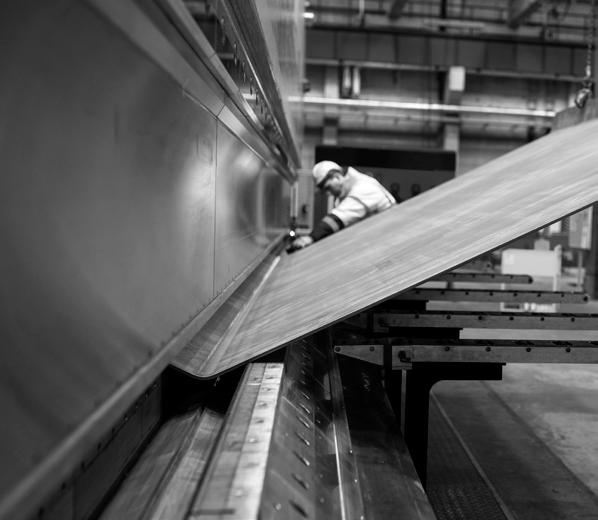
This brochure contains recommendations for bending of Toolox®. It is intended as a guide, and contains general suggestions for how to achieve the best results when bending.
Bending high-strength steel rarely proves to be difficult. However, there are certain parameters that must be considered. A highly pure steel material with few inclusions is fundamental to achieving a good bending result. SSAB’s modern processing allows for high standards of surface quality, tolerances and mechanical properties.
Preparation
- Check the rolling direction of the plate. If possible, orient the rolling direction perpendicular to the bend line. The plate can often be bent tighter this way, than with the bend line parallel to the rolling direction.
- Check the surface quality of the plate. Surface damage can reduce bendability as it can be the cause of fractures. Defects on the plate such as scratches and rust can often be removed with careful grinding. Preferably grind any scratches perpendicular to the bend line.
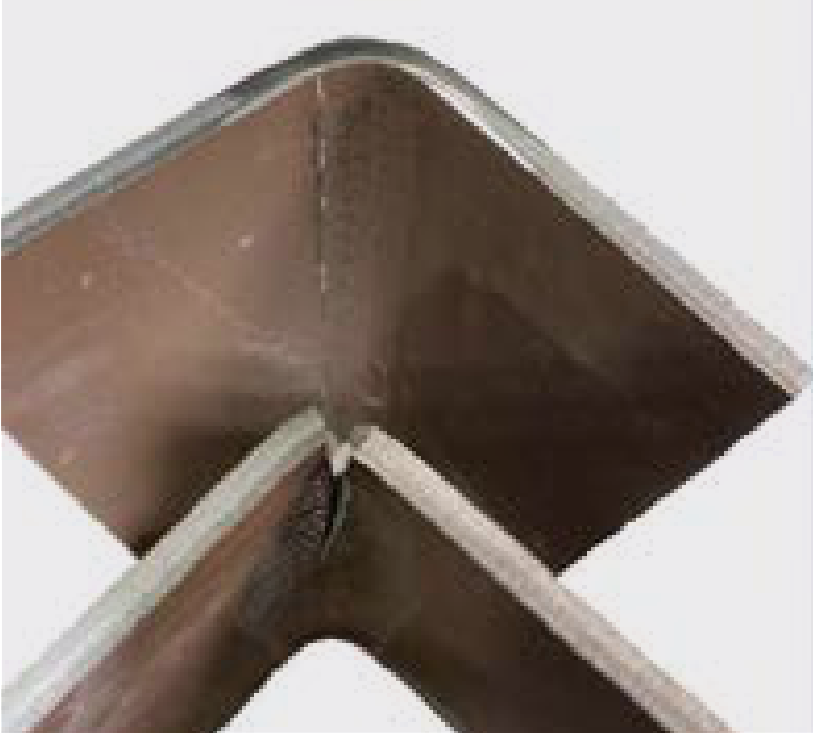
- Thermal cut and sheared edges should be deburred and rounded with a grinder. This is especially important when bending Toolox® 44, which is sensitive to any irregularities. See Figure 1.
- Check the condition of the tools. To avoid excessive tool wear, tooling should be harder than the workpiece. Check that the tools and tool setup are in line with the recommendations.
Figure 1. Toolox® 44 with same punch used on a deburred and nonburred edge.
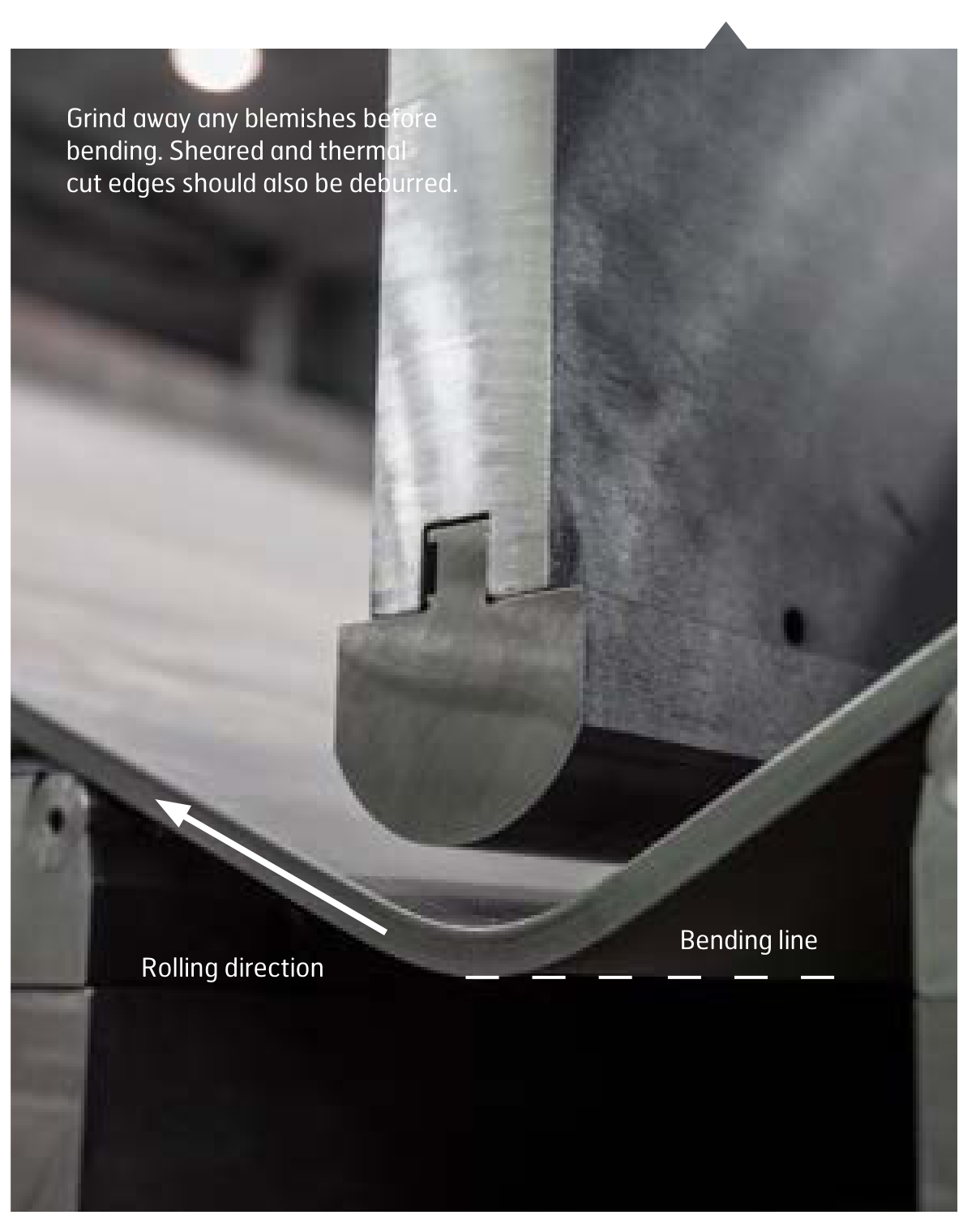
Figure 2. Bending transverse to the direction of rolling. The edges of the die opening should always be as hard as, or harder than, the plate being bent, in order to avoid excessive damage to the die. A simple way of achieving this is to mill grooves in the die edges and fit lubricated round rods of, for example, hardened steel into the grooves. The edge radius of the die should be at least half the plate thickness.
To consider
- Always take safety precautions and follow local safety regulations. Only qualified people may be by or in the vicinity of the machine. When high-strength steel is being bent, nobody should stand in front of the press brake.
- Check that the punch together with the workpiece do not bottom out in the die.
- Consider springback. Avoid rebending to correct the profile angle. The exposure of a material to previous forming processes reduces its bendability to a great extent.
- Bending force, springback and, in general, minimum recommended punch radius increase with the strength of the steel.
- In many Toolox® plate products, the identity of the plate is stamped perpendicular to the rolling direction. Avoid placing the bending line over the stamp due to the risk of cracking.
- Excessive blast cleaning can have a negative effect on bendability. Recommendations for Toolox® products are based on tests with blast cleaned and painted surfaces.
- High strain rate may cause a local temperature increase in the bend. This could have an adverse impact on the bendability, especially for thicknesses above 20 mm (0.787”).
- If possible, reduce the punch speed, in order to decrease the temperature difference within the workpiece.
Tools
Die width
Springback increases with increased die width, while punch force is reduced. Make sure that the opening angle of the die allows for over-bending, without bottoming out, to compensate for springback. An increased die opening width can in many cases lower the strain level in the bend. Also, make sure that there is enough room for the chosen punch together with the workpiece in the die during bending, without deforming the die. The minimum recommended die opening widths are shown in table 1. The die edge radius should be at least half the plate thickness. Alternatively, the die width should be increased in order to minimize pressure on the die edge radius, and consequently reduce the risk of die marks.
Punch
The suitable punch radius, along with the die width, is the most important parameter. When bending high-strength steel, the final inner radius often becomes somewhat smaller than the radius of the punch, Figure 3. When there is low friction between plate and tools, the phenomenon becomes more obvious.
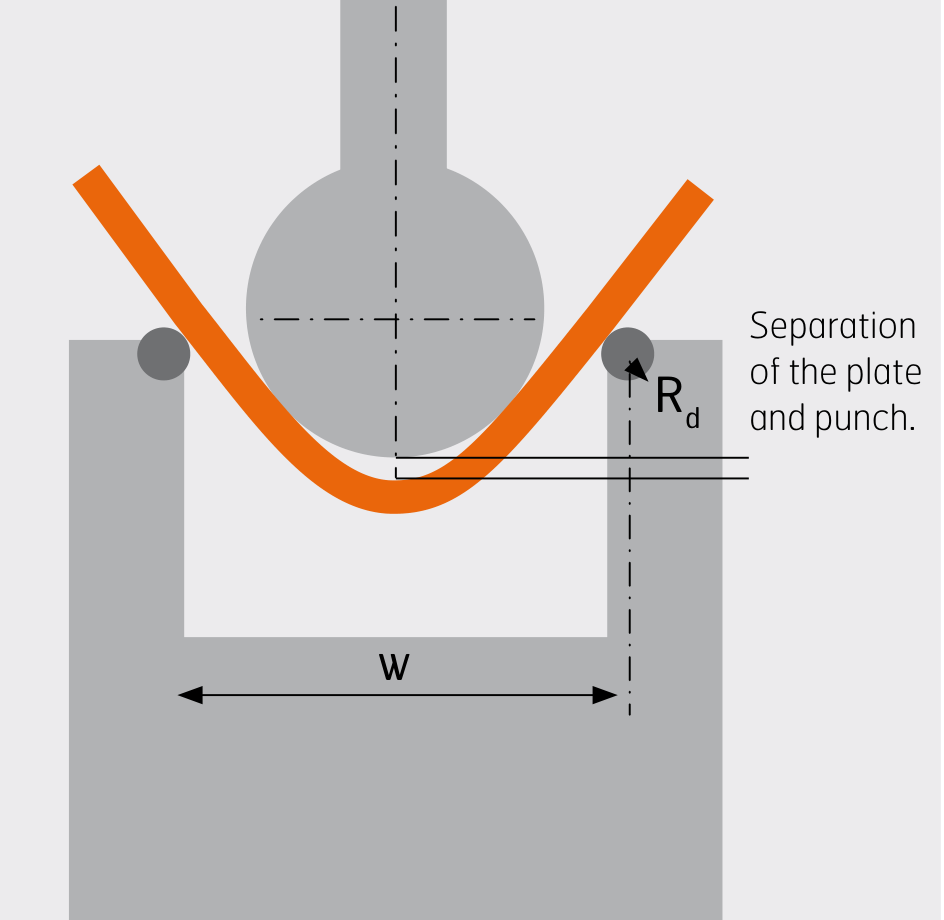
Figure 3. Separation of the plate during bending.
Machine stability
Required punch force is often high when bending high-strength steel. The static friction coefficient is typically higher than the kinetic. This can cause the plate to lock over the edge of one die edge radius, and at the same time slide over the other one. In this way, the workpiece swings down into the die in a discontinuous way during the bending process. This phenomenon, called stick-slip, can result in higher strains over the bend. Use a stable machine and steady tool fastening. Lubrication of the die edge or use of a rotating die edge radius can be helpful, avoiding stick-slip and also lowering the punch force.
Condition of tools
Due to the increased contact pressure between plate and tools when bending Toolox®, wear on the tools increases somewhat. Check regularly that the punch radius and die edge radius are both constant. The edges of the die should remain clean and undamaged.
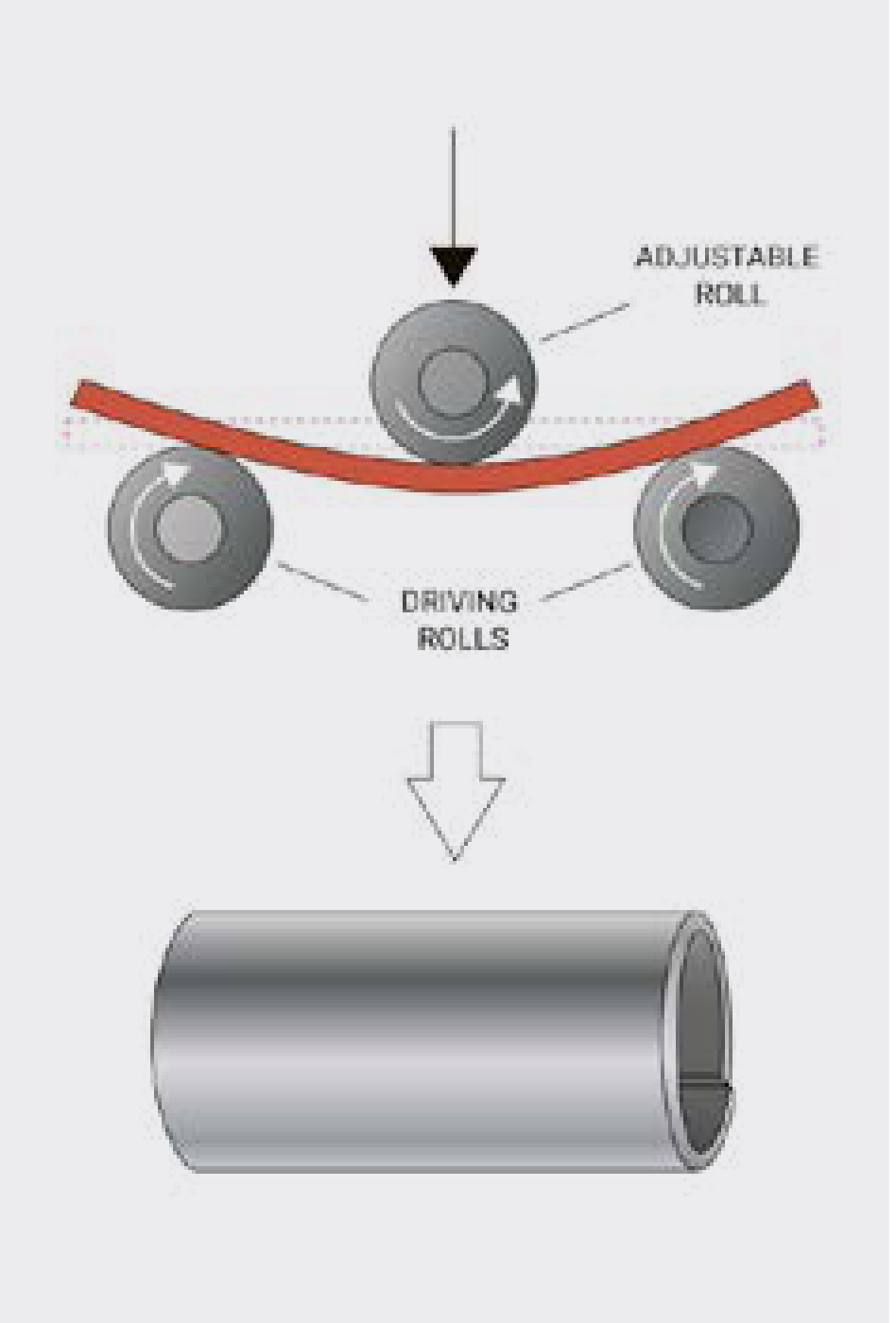
Roll bending
Roll bending is a process used to roll plates into cylinders, cones, curves and other shapes. The plate is rolled between rollers to achieve the curvature. To achieve a permanent deformation the plate must be tensed above the material’s yield strength. The higher yield strength the more force is needed to reach a plastic deformation, simultaneously the springback is increased. When the force is increased, the risk for deflection of the top roll also increases. The diameter of the top roll sometimes has to be decreased to be able to compensate for the springback. At the same time it has to be stable enough during force without undergoing deflection. High-strength steel can be roll bended, if the machine requirements are right, that is if you can receive the needed bending force without deflection of the top roll.
Springback
Springback increases with steel strength and the ratio between die width and plate thickness (W/t). Material yield strength has the biggest influence. When bending, a varying residual stress distribution is achieved over the bend cross section. The plastic strain level and the distribution of these stresses will control the tendency for springback. All springback is fully elastic. To compensate for springback, the die should be shaped in such a way to allow overbending without coining the material. It is very difficult to accurately predict the springback of a material when bending, since this depends to a large extent on each unique tool setup. That is why trials are recommended. For thinner plate or sheet (t < 10 mm (0.394”)), you can estimate the material’s springback, in degrees, by dividing the tensile strength (MPa) by 100. A precondition is that the die width is approximately 10–12 x the plate thickness.
Parameters that affect springback
- Yield strength of the material – higher yield strength causes greater springback.
- Punch radius – increased punch radius will cause greater springback.
- Die width – larger die width causes greater springback.
- The strain hardening of the material.
Bending recommendations
These bend recommendations are based on bend tests of one step to 90° after unloading. Rp is the recommended punch radius to use. Die opening widths (W) are guidelines and may vary somewhat without affecting bending results.
Table 1. The bending recommendations for Toolox® are based on dies with rolls and normal friction (no lubrication). Rp/t stands for punch radius (Rp) divided by sheet thickness (t).
Toolox® grade | Thickness range [mm] | Transverse to rolling direction minimum Rp/t | Along rolling direction minimum Rp/t | Die opening width (W) minimum W/t |
|---|---|---|---|---|
Toolox® 33 | 6<t<20 | 2.5 | 2.5 | 12 |
Toolox® 44 | 6<t<20 | 3 | 3.5 | 12 |
Bending force
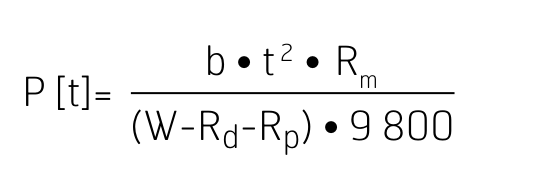
To make an estimation of the force needed during bending, consider not only the bend length, plate thickness, die width and tensile strength, but also the changing moment arm during bending. The peak load is assumed to be reached at a bend opening angle of 120° with normal friction (no lubrication). Trial tests are always recommended.
- P = Bend force, tons (metric)
- t = Plate thickness, mm
- W = Die width, mm (table 1)
- b = Bend length, mm
- Rm = Tensile strength, MPa (table 2)
- Rd = Die entry radius, mm
- Rp = Punch radius, mm
The SSAB Bending Formula© is verified in tests for 90° bends.
Table 2. Typical tensile strength values to calculate bend force.
Toolox® grade | Typical tensile strength [MPa] |
|---|---|
Toolox® 33 | 980 |
Toolox® 44 | 1450 |