



Armox® Cutting
Cutting recommendations
All high-hardness Armox® plate should be cut under controlled conditions as described below. Table 4 gives the preferred method for each grade and thickness.
Table 4. Preferred cutting methods. A blank cell means the method row does not apply to that grade.
Armox® 370T CL 1 & 2 | Armox® 440T | Armox® 500T | Armox® 520T | Armox® 560T | Armox® 600T | Armox® 620T | Armox® Advance | Recommended cutting method |
|---|---|---|---|---|---|---|---|---|
Up to 15 mm | Up to 25 mm | Up to 15 mm | Up to 12 mm | Up to 15 mm | Up to 10 mm | Abrasive waterjet Plasma Laser Abrasive disc | ||
15–25 mm | 25–30 mm | 15–25 mm | 10–20 mm | Abrasive waterjet Laser Gas cutting plus preheating to 170 ± 30 °C Abrasive disc | ||||
40–100 mm | 25–30 mm | 40–80 mm | Abrasive waterjet Gas cutting plus preheating to 170 ± 30 °C plus keep warm for 4 hours at 160 ± 40 °C Abrasive disc | |||||
Up to 15 mm | Up to 12 mm | Abrasive waterjet Abrasive disc Laser |
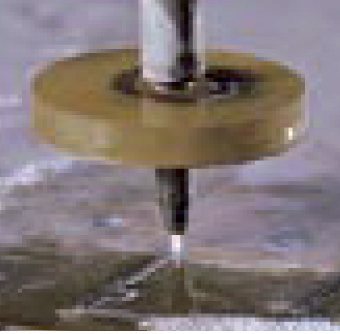
Abrasive waterjet
This process can be applied to all of the Armox® plates and is the preferred method, because the absence of HAZ eliminates the risk of cracking.
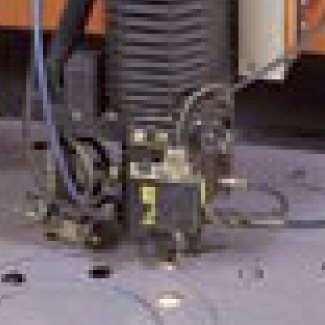
Laser cutting
Armox® Advance and Armox® 600T up to around 20 mm thick can be cut using this process. It generates a narrow kerf, usually less than 1 mm, and a narrow HAZ, usually less than 3 mm.
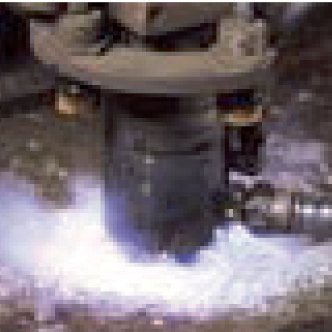
Plasma cutting
Armox® Advance and Armox® 600T up to around 25 mm thick can be cut using this process. It generates a kerf, usually 3–4 mm, and a HAZ up to 5 mm. Plasma cutting can be performed under water, which minimizes the amount of distortion and generates a more narrow HAZ.
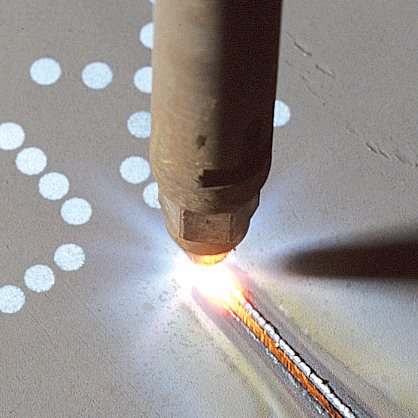
Gas cutting
This process can be applied to Armox® plates up to 100 mm thick, see details in Table 4. It generates a kerf of 2–5 mm and a HAZ which is usually 4–10 mm wide.
Uncontrolled gas cutting of high-hardness armour plate may result in hydrogen cracking (also called cold cracking) which may occur in thicknesses above 20–30 mm. The thicker the plate, the higher the sensitivity to cracking.
The most effective technique for avoiding cracking during and after the cutting process is to preheat the plate and then keep the cut parts at an elevated temperature as can be seen in Table 4.
Preheating consists of bringing the whole plate, or at least a 100 mm wide area on either side of the future kerf, up to a specified minimum temperature before the process begins. This can be done by using thermostatically controlled furnaces, heating blankets or, in some cases, using gas burners to maintain the temperature throughout the process.
The same equipment can be used to keep the cut parts at an elevated temperature as can be seen in Table 4. Reduced cutting speed is possible only when the cut parts are wide enough to consume the excessive heat. If in doubt contact SSAB.
Abrasive disc
This process is usually applied to the cutting of tube and rod but can also be adopted for straight line cutting of the complete range of high-hardness Armox® plate. The kerf is the thickness of the disc, with narrow or no HAZ.
Contact and more information
Contact your local SSAB representative or Tech Support at [email protected], or visit www.ssab.com.
This leaflet contains general suggestions and calculation models. It is the responsibility of the user to adapt the recommendations contained herein to the requirements of individual applications.