




Duroxite® Handling
BEAD ORIENTATION
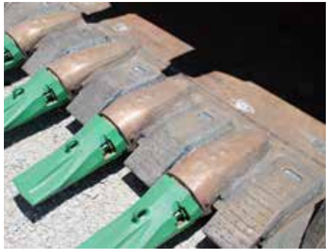
Theoretically, when abrasives flow at a 45 degree angle relative to the welding bead orientation of the overlay plate, it gives optimum wear resistance. This can however be difficult to achieve in practical applications. For a Duroxite® plate with straight welding beads, it is recommended to apply the plate with the abrasives flowing across the welding beads, at a transverse orientation. When abrasives flow along the welding bead orientation it reduces the wear resistance. That is why the ASTM G65 wear test sample is cut at this orientation to evaluate the worst case scenario.
REPAIRING AFTER CUTTING
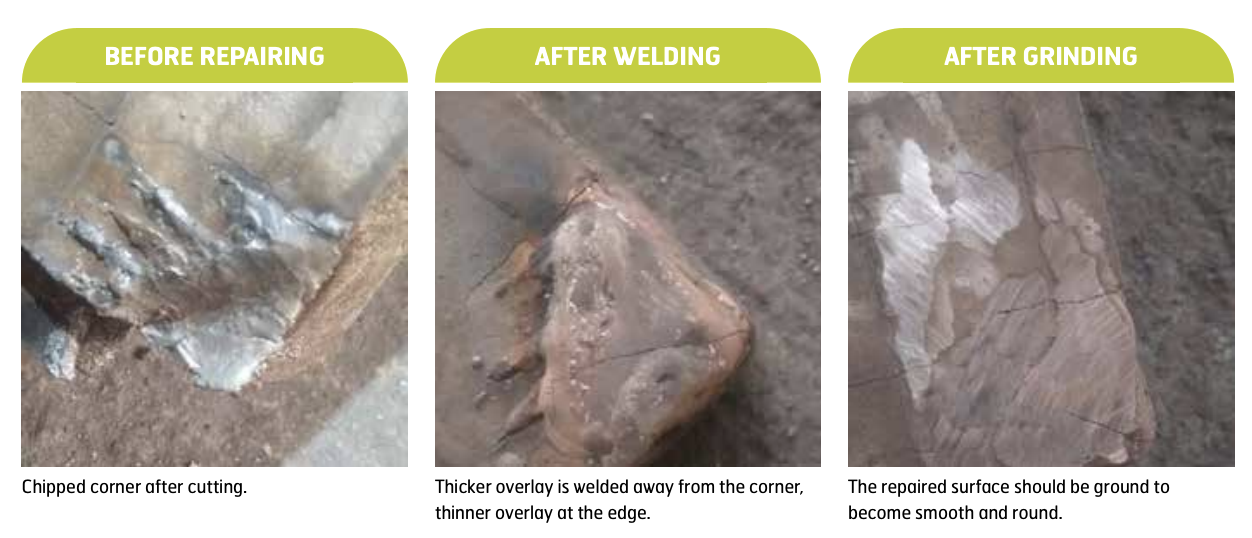
When cutting Duroxite® plates, chipping or spalling may occur at the corners of a plate. This rare issue is caused by transverse cracks in Duroxite® plates, which are formed to relieve residual stress during welding. To address this, we recommend following the touch-up procedures outlined below.
LIFTING, HANDLING AND TRANSPORTING
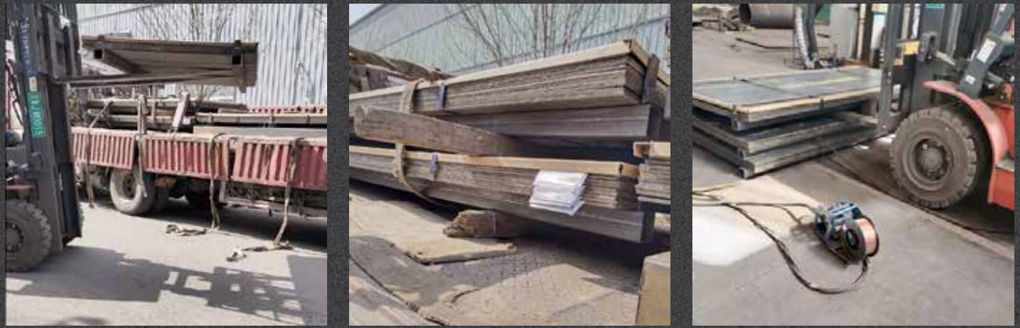
Duroxite® plates are flat when delivered to facilitate cutting on plasma and laser machines. While handling and transporting, it is important the plates are supported by stiff beams that stretch the entire length of the plates to avoid buckling and bending.
Duroxite® plates should always be supported when handling and transporting to ensure they stay flat.